
Reimagining M. Chinnaswamy Stadium as a Fan-First Experience
- gad the mad
- Jun 16
- 5 min read
A conceptual visualization by GAD inspired by the energy, emotion, and collective theatre of Royal Challengers Bengaluru.
There are stadiums that host matches, and then there are stadiums that hold memory.
M. Chinnaswamy Stadium has always belonged to more than cricket. It belongs to anticipation, noise, colour, loyalty, heartbreak, hope, and the thousands of people who arrive not merely to watch a game, but to become part of something larger than themselves.
This conceptual reimagination by GAD explores what a modern cricket stadium could become when the fan experience is placed at the centre of the design narrative. Inspired by the unmistakable energy of Royal Challengers Bengaluru, the project looks beyond structure, seating capacity, and façade expression to ask a deeper question:
What should it feel like to arrive at a stadium before the first ball is bowled?
The Stadium as an Urban Landmark

From above, the stadium is imagined as a civic anchor — a powerful architectural presence sitting within the rhythm of the city. Its circular form becomes more than a sports venue; it becomes a recognizable urban landmark, surrounded by greenery, public movement, and the pulse of Bengaluru.
The design proposes a stadium that feels open, visible, and connected to its surroundings. Rather than existing as an isolated object, it becomes part of the city’s daily life — a place that transforms dramatically on match days, but still belongs to the urban fabric around it.
The façade, defined by repeated vertical fins and a layered skin, gives the stadium a sense of scale and movement. It feels dynamic even when still, as if the energy of the crowd has been translated into architecture.
Arrival as Ritual

A stadium experience does not begin at the seat. It begins much earlier — in the walk toward the gates, in the sound of crowds gathering, in flags rising above the movement, in families and friends making their way toward the same shared destination.
This project treats arrival as a ritual.
The approach sequence is imagined as a gradual build-up of emotion. Landscaped edges, broad pedestrian routes, fan zones, and a monumental façade come together to heighten the sense of occasion. Every step closer to the stadium becomes part of the story.
The architecture is not passive here. It participates in the anticipation.
When the Stadium Comes Alive at Night

By night, the stadium transforms.
The façade becomes a canvas of light, colour, and identity. Red illumination washes across the vertical fins, amplifying the presence of the building and turning it into a beacon for match-day celebration.
The crowd approach becomes almost cinematic — flags in motion, warm lighting, haze, and the glow of the stadium pulling people forward. The design imagines the stadium not only as a destination, but as a visual and emotional magnet within the city.
This is where architecture begins to move beyond function. It becomes atmosphere.
The Concourse as a Social Stage

The concourse is often treated as a transitional space — a place to pass through. In this reimagination, it becomes one of the most important parts of the stadium experience.
Here, the fan journey is intensified through scale, light, digital displays, banners, and movement. The architecture frames a world of anticipation: people gathering, screens flashing, chants echoing, and the identity of the team woven into the spatial experience.
This is not just circulation.It is the emotional lobby of the stadium.
Every surface, every column, every light line contributes to the feeling that something is about to happen.
The Threshold Moment

One of the most powerful moments in any stadium is the first glimpse of the field.
The tunnel opens. The light shifts. The sound expands.
The crowd appears all at once.
This visual captures that threshold, the moment when architecture gives way to spectacle. A father and child stand at the edge of the bowl, turning the experience into something deeply human.
Stadiums are not only remembered through matches; they are remembered through moments like this.
The design understands that scale alone does not create emotion. People do.
Rethinking the Act of Watching

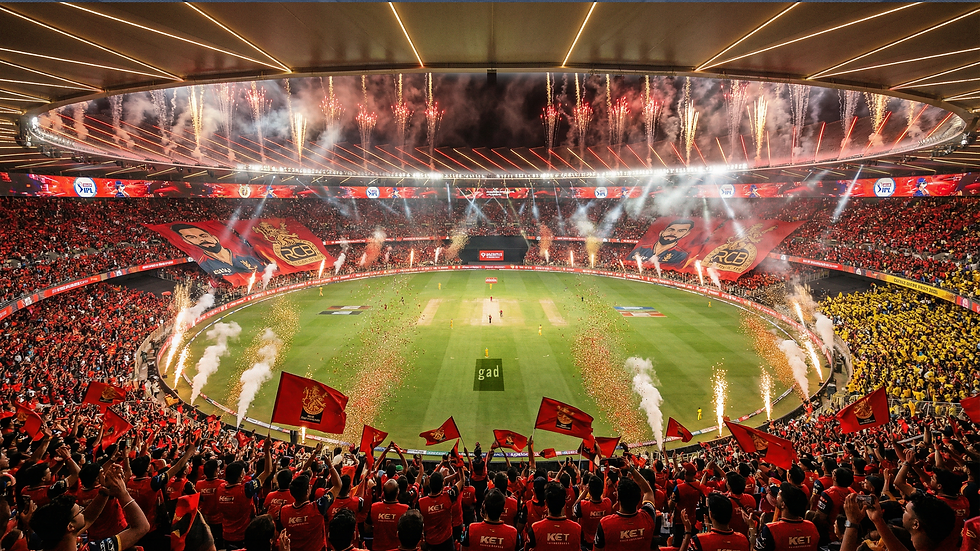
To watch cricket in a stadium is to experience the game differently. The field, the sound, the distance, the pressure, the collective reaction — everything is heightened.
This image shifts the perspective from the spectator to the centre of play, placing the viewer inside the drama of the match. The stadium bowl wraps around the action, creating a sense of immersion and intensity.
The architecture is designed to amplify the game — not overpower it. The crowd becomes a wall of energy, the roofline frames the sky, and the stadium becomes a theatre where every ball feels monumental.
Celebration as Architecture
The heart of this concept lies in the belief that a stadium is not defined only by the game it hosts, but by the emotions it allows people to feel together.
Fireworks, flags, light, sound, and collective movement turn the interior bowl into a theatre of celebration. The stadium becomes a vessel for shared identity, a place where thousands of individual emotions gather into one atmosphere.
This is where sport, architecture, and storytelling meet.
A Nighttime Icon for the City

Seen from above at night, the reimagined stadium becomes a glowing landmark. The red-lit façade, the illuminated bowl, and the surrounding city lights create a powerful urban image — one that suggests both spectacle and belonging.
The project imagines how a stadium can become part of a city’s visual identity. Not just during the match, but before and after it. Not just as infrastructure, but as memory.
A building like this does not disappear after the final over. It stays in the mind.
A Passion-Driven Exploration by GAD
This conceptual project was created as a passion-driven exploration by GAD, inspired by the emotional force of cricket culture and the unforgettable energy of Royal Challengers Bengaluru.
For us, visualization is not only about showing architecture. It is about revealing what architecture can make people feel.
Through these images, we wanted to explore a stadium as an emotional landscape — a place of arrival, anticipation, intensity, connection, and celebration. A place where the experience of the fan is not secondary to the architecture, but central to it.
Because great design does not begin with form alone.
It begins with feeling.
GAD creates cinematic architectural visuals that help ideas feel real before they are built.
From conceptual storytelling to immersive visual narratives, we craft images that communicate atmosphere, intent, and experience.


Comments